Overview
Paylocity's Marketplace lets customers discover, evaluate, purchase, and implement third-party integrations, everything from 401(k) providers to benefits administration tools, directly within their HR & Payroll platform. It's designed to work as a self-service storefront: customers find a partner, request the integration, and work with a Partner Implementation Team to get it set up.
I led research to understand the entire end-to-end Marketplace experience, including discovery, evaluation, purchase, and implementation, across two rounds of moderated usability testing and interviews with 23 HR administrators.
The Problem
Marketplace was a strategic priority: the business wanted to grow self-service Marketplace revenue and reduce the load on Sales and Support teams who were fielding integration requests manually. But Marketplace was originally designed with a narrow user in mind, HR admins, while in reality, a much wider range of people were interacting with it, from brokers to developers to enterprise IT leads.
Leadership needed to know: where in the journey, discovery, evaluation, purchase, or implementation, were customers getting stuck, and why?
Research Goals
- Map the end-to-end process customers go through to discover, purchase, implement, and manage an integration.
- Identify usability, usefulness, and other barriers across the client-facing Marketplace experience.
- Establish a baseline measure of perceived usability (SUS) and usefulness to track improvement over time.
Research Approach
I ran two rounds of moderated, remote usability studies and interviews:
- Round 1 (15 participants): Stakeholder interviews with Sales & Implementation, a usability test of the purchase flow, and a customer-journey interview, paired with SUS collection, focused on overall findability and the purchase experience.
- Round 2 (8 participants): A usability study and workflow evaluation, also with SUS collection, focused on evaluating two real integration workflows end to end: a Data Integration (401(k) provider) and a Weblink Integration (Ease, a benefits administration platform), including the implementation emails customers receive afterward.
Participants were HR admins responsible for finding and executing integrations, managing recruiting, benefits enrollment, or personnel records. The group included 16 current Paylocity customers and 7 non-customers, spanning Financial Services, IT Services, Health, Manufacturing, Property Management, and Education, at companies ranging from 20 to 1,000 employees.
Key Findings
80
SUS score, above the industry average of 68, but masking real usability gaps in discovery and purchase.
50%
of participants couldn't successfully find Marketplace on their own; the other 50% failed the task entirely.
88%
completed "find an integration" successfully once inside Marketplace. The entry point was the real blocker.
75
perceived usefulness score, reflecting how well participants felt Marketplace met their needs once they got there.
Despite a strong topline SUS score, four core issues consistently blocked customers from discovering, evaluating, purchasing, and implementing integrations successfully:
-
Marketplace isn't discoverable. Participants expected to find integration management under Configurations in HR & Payroll. Their mental model was that an integration is something you configure, not something you shop for. Marketplace's "storefront" framing didn't match how customers think about integrations at all, so many never found it.
-
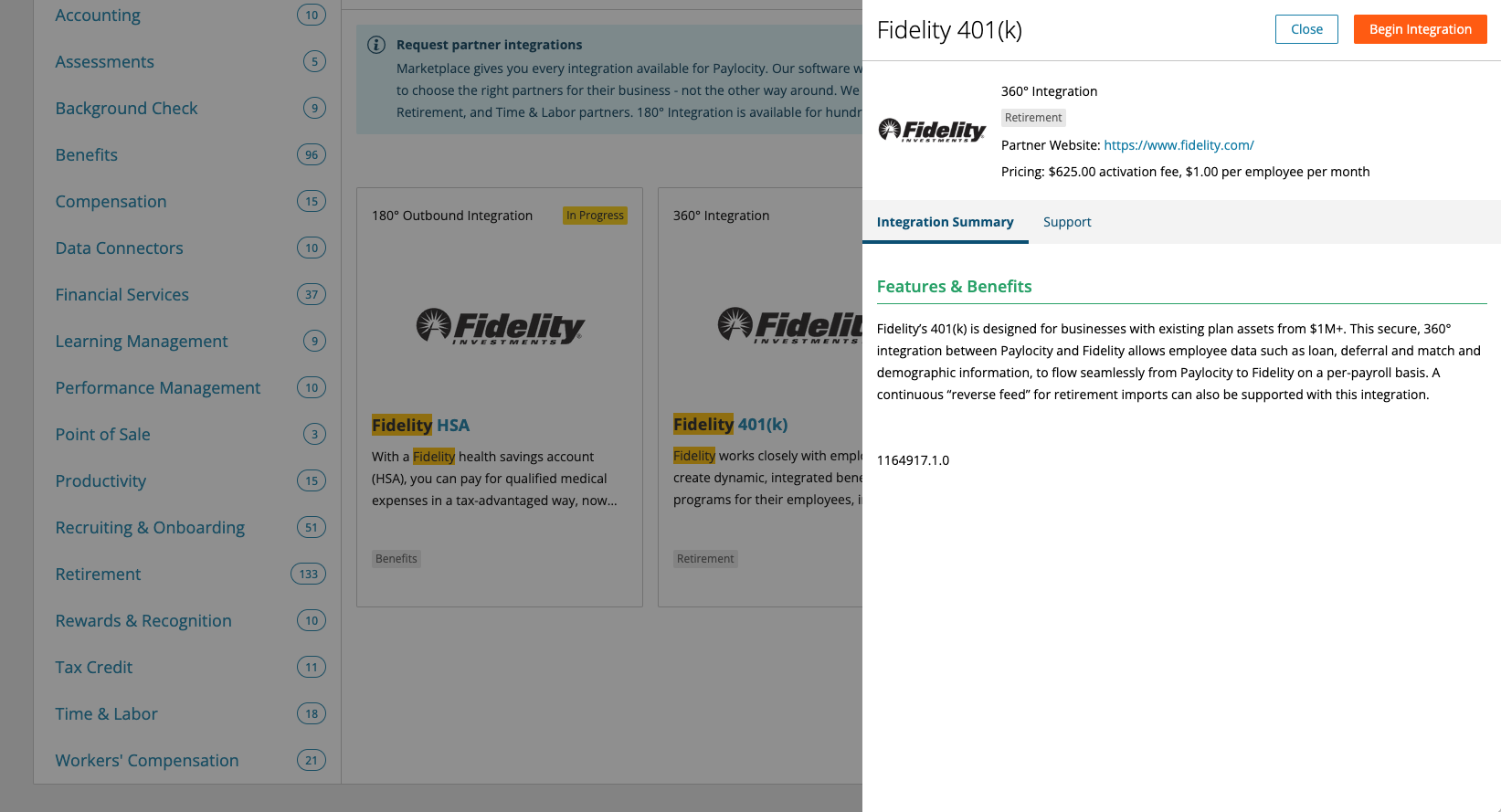
Missing information blocks confident purchasing decisions. Integration descriptions were missing key details, such as what data fields are pushed or pulled, what counts as an "employee" for pricing purposes, and how much the tech partner itself charges. Unclear terminology like "180/360 Integration" left participants with unresolved questions they couldn't answer on their own.
-
Expert support is hard to reach, both before and after purchase. Before buying, customers struggled to find someone at Paylocity who could answer technical questions. After implementation, when data wasn't syncing correctly, they were left troubleshooting alone. One participant, an HR Manager at Planned Parenthood, described it directly:
"A few months ago, I had an Ease integration, and I didn't get an email letting me know… and the salesperson reached back out to me months later… and said it was done. There was definitely a breakdown in communication."
Jamille Hamlet, Human Resources Manager, Planned Parenthood
-
"Begin Integration" doesn't match expectations. Clicking this button surprised participants. They expected an automated process to kick off, but instead landed on an Integration Request Form. The same label pointed to different destinations across different integration drawers, compounding the confusion.
-
Implementation status is invisible. Once a purchase was made, customers had no reliable way to track where they stood. Status updates arrived via email, but those emails got lost in the volume of communications customers already receive from Paylocity. On top of that, implementation timelines varied unpredictably between integration types, with no explanation of why.
Recommendations & Impact
I grouped recommendations by where in the journey they'd have the most impact, prioritizing short-term fixes the team could act on quickly alongside longer-term investments:
- Improve discoverability: add entry points to Marketplace from within the Configurations tab and other places customers naturally look when thinking about integrations, paired with further research to identify the highest-value placements.
- Close information gaps: enrich integration descriptions with feature details, UI screenshots, data field lists, and clearer pricing guidance, including working with tech partners to surface their own pricing.
- Make expert help reachable: short term, add a "Contact an Expert" button directly in Marketplace; long term, build out fuller integration summaries and explore an AI assistant for technical questions.
- Fix the "Begin Integration" button: re-evaluate this CTA across every integration drawer and update copy to match the actual destination (e.g., "Continue to Purchase" for ADP).
- Surface implementation status in-product: pull live status from Salesforce into Client Hub / My Integrations, provide average time estimates after purchase, and give customers direct contact info for their Partner Implementation team rather than a generic inbox.
These recommendations were prioritized with the Product and Partner Integration teams for near-term implementation, and shared with the Vision Design team to inform the longer-term Marketplace roadmap.
Reflections
The biggest lesson from this project was how much a strong topline metric (an 80 SUS score, above the industry average) can mask underlying friction. Half of participants couldn't even find Marketplace, a problem no usability score on the "inside" of the product would ever surface. It reinforced how important it is to test the entire journey, including the parts that happen before someone reaches the product, not just the polished flows inside it.
It also underscored a recurring theme across enterprise research: customers don't think in terms of product taxonomy ("Marketplace"), they think in terms of their own workflows ("I need to configure an integration"). Designing, and naming things, around the customer's mental model rather than the org chart is something I now bring into every research plan.